Texas Security Deposit Deductions: Itemized List, Receipts, Invoices & the 30-Day Rule
Texas generally requires an itemized deposit deduction list, but not an attached receipt for every charge. Learn the 30-day rule and what supports a dispute.
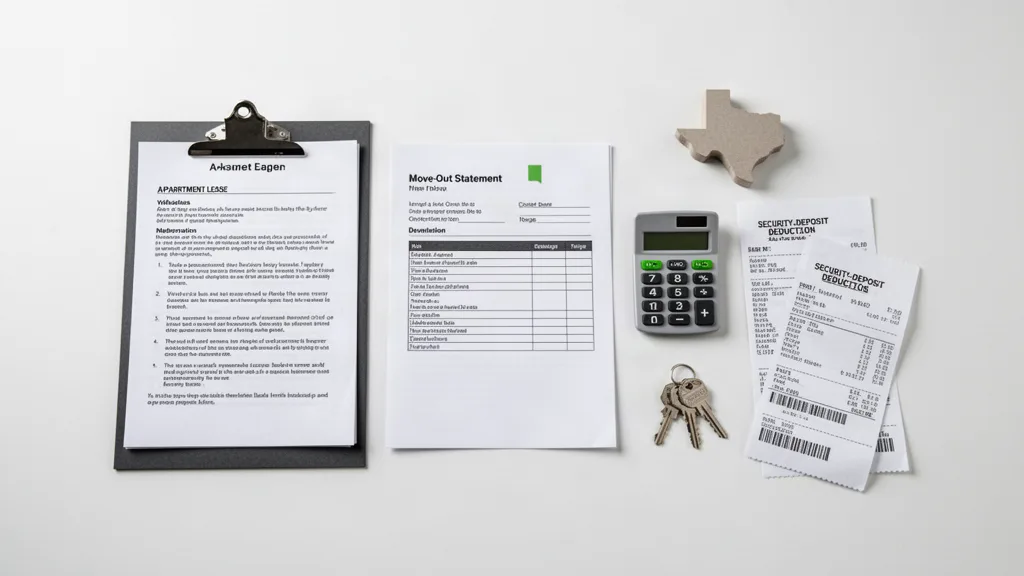
The short answer
Texas Property Code section 92.104 generally requires a landlord who keeps all or part of a residential security deposit to give the tenant any remaining balance together with a written description and itemized list of deductions. The statute permits deductions for damages and charges for which the tenant is legally liable under the lease or because of a lease breach, but it prohibits deductions for normal wear and tear.
The statute expressly requires the written description and itemized list in most cases, but sections 92.103 through 92.109 do not expressly say that a paid contractor invoice or receipt must be attached to every deduction. That does not make an unsupported charge automatically reasonable. If a tenant challenges the withholding under this subchapter, section 92.109 places the burden on the landlord to prove that retaining the disputed amount was reasonable.
Texas requires an itemized accounting in most deposit disputes
Section 92.104(c) says that when a landlord retains all or part of a security deposit, the landlord must give the tenant the remaining deposit, if any, together with a written description and itemized list of all deductions. The Texas Attorney General likewise tells renters that if part or all of a deposit is withheld, the landlord must provide an itemized list of deductions with a description of the damages.
An itemization should identify what was charged rather than present one unexplained lump sum. A tenant comparing the statement with the lease, move-in record and move-out evidence should be able to tell which condition or obligation each deduction relates to.
Does Texas require receipts or paid invoices with every deduction?
The current residential security-deposit statute requires an itemized written accounting, but it does not expressly require that a contractor receipt, paid invoice or material receipt be attached to every line item. A tenant should therefore avoid treating the absence of an attached receipt, by itself, as automatic proof that the deduction is invalid.
The opposite assumption is also unsafe. A landlord does not gain an unlimited right to keep an amount simply by writing it on an itemized list. The charge still must be one for which the tenant is legally liable, it cannot be normal wear and tear, and section 92.109(c) states that in a tenant action under the security-deposit subchapter the landlord has the burden of proving that retention of any portion of the deposit was reasonable.
What evidence can support or challenge a deduction?
Receipts and invoices can be useful even though the statute does not expressly require one to be attached to every accounting. Other useful records include contractor estimates, work orders, photographs, move-in and move-out condition reports, dated maintenance requests, the lease, replacement-cost information, cleaning records, repair communications and evidence showing the age or prior condition of the item.
For landlords, preserving records that connect the condition, responsibility and amount can help explain why a deduction was reasonable. For tenants, before-and-after photos, prior repair requests and the original condition record can help distinguish tenant-caused damage from ordinary deterioration or a preexisting problem.
Normal wear and tear cannot be charged against the deposit
Section 92.104(b) prohibits retaining security-deposit money for normal wear and tear. The Texas Attorney General explains this with ordinary deterioration such as carpet becoming worn from normal walking, while abnormal tenant-caused damage may be chargeable.
A useful review therefore separates three questions: what condition existed at move-out, whether the tenant was legally responsible for it, and whether the amount kept was reasonable. An itemized statement answers only part of that analysis; the tenancy evidence fills in the rest.
The ordinary deadline is 30 days after surrender, subject to the forwarding-address rule
Section 92.103 generally requires the landlord to refund the security deposit on or before the 30th day after the tenant surrenders the premises. Section 92.107 provides an important qualification: the landlord is not obligated to return the deposit or provide the written description of damages and charges until the tenant gives a written forwarding address for the purpose of refunding the deposit.
Keep proof of surrender, key return, the written forwarding address, the postmark or delivery date of the accounting, and the refund record. These dates can matter if the parties later disagree about whether the 30-day requirement was satisfied.
There is a narrow exception to the itemized-list requirement
Section 92.104(c) states that the landlord does not have to give the written description and itemized list when the tenant owes rent at surrender and there is no controversy concerning the amount of rent owed. The exception is written around undisputed rent owed at surrender, not around every type of claimed damage, fee or repair charge.
If the landlord relies on this exception, keep the final rent ledger and any communications showing whether the rent amount was actually disputed. Claims for damage, cleaning, utilities or other charges should not automatically be treated as undisputed rent merely because a balance appears on the ledger.
Bad-faith remedies exist, but do not assume an automatic award
Section 92.109 addresses bad-faith withholding and bad-faith failure to provide a required written description and itemized list. It also creates a presumption of bad faith when the landlord fails either to return the deposit or provide the required itemization by the applicable 30-day deadline.
Do not reduce those provisions to an automatic promise of triple damages in every late or disputed deposit case. The surrender date, forwarding-address record, statutory exception for undisputed rent, the reasonableness of the deductions and evidence of bad faith can all matter. A court may have to resolve disputed facts.
A practical way to review the statement
Read the accounting line by line. For each deduction, identify the lease or legal basis, the condition claimed, whether it existed before the tenancy or reflects normal wear, the amount charged, and what evidence supports the amount. Request clarification and supporting records in writing for charges that are vague, duplicated or difficult to connect to the rental condition.
Keep the discussion factual. A tenant does not need to assume that every deduction is valid simply because it is itemized, and a landlord does not need to assume that every deduction requires a paid third-party invoice if other evidence can establish the condition, responsibility and reasonable amount. The current Texas statute and the actual evidence control the dispute.
Use Max Rental Tools to organize the security-deposit record
Max Rental Tools includes Security Deposit Itemization, Security Deposit Refund Statement, Move-Out Condition Report, Property Photo Evidence Log, Resident Communication Record and Rent Ledger workflows. These tools can help organize the dates, condition evidence and deduction calculations while Texas Property Code Chapter 92 and current Texas Attorney General guidance remain the controlling sources.
For a significant or contested withholding, preserve the complete file and consider qualified Texas landlord-tenant legal help or the appropriate court process rather than relying on community comments as the legal authority.
Common questions
Does a Texas landlord have to give an itemized list of security-deposit deductions?
Generally yes when all or part of a residential security deposit is retained. Section 92.104(c) requires a written description and itemized list, subject to a narrow exception when undisputed rent is owed at surrender.
Does Texas law require a receipt or paid invoice for every security-deposit deduction?
Sections 92.103 through 92.109 require the accounting and regulate deductions, but they do not expressly say a paid receipt or contractor invoice must be attached to every line item. Supporting records can still be important because a disputed withholding must be legally valid and reasonable.
Can a Texas landlord charge normal wear and tear against the deposit?
No. Section 92.104(b) says a landlord may not retain any portion of the security deposit to cover normal wear and tear.
How long does a Texas landlord have to return the security deposit?
Section 92.103 generally uses a 30-day deadline after the tenant surrenders the premises, subject to section 92.107's written-forwarding-address rule.
Who has to prove that a Texas security-deposit deduction was reasonable?
In an action brought by a tenant under the security-deposit subchapter, section 92.109(c) says the landlord has the burden of proving that retention of any portion of the deposit was reasonable.
Official sources
Texas Legislature — Property Code Chapter 92, Residential TenanciesTexas Attorney General — Renter's RightsContinue your check
Use the state directory for current jurisdiction-specific rules, calculate the proposed increase, then prepare the appropriate rental document only after the legal-rule checks are complete.